


Silver is sinking
November 18, 2026 @ 18:15 +03:00
by /  Add FxPro.News on Google
Add FxPro.News as your preferred source to see more of our posts on Google.
- A burst bubble, unfavourable market conditions and declining demand are dragging silver down.
- Silver is falling faster than gold due to volatility and differing trends in ETF holdings.
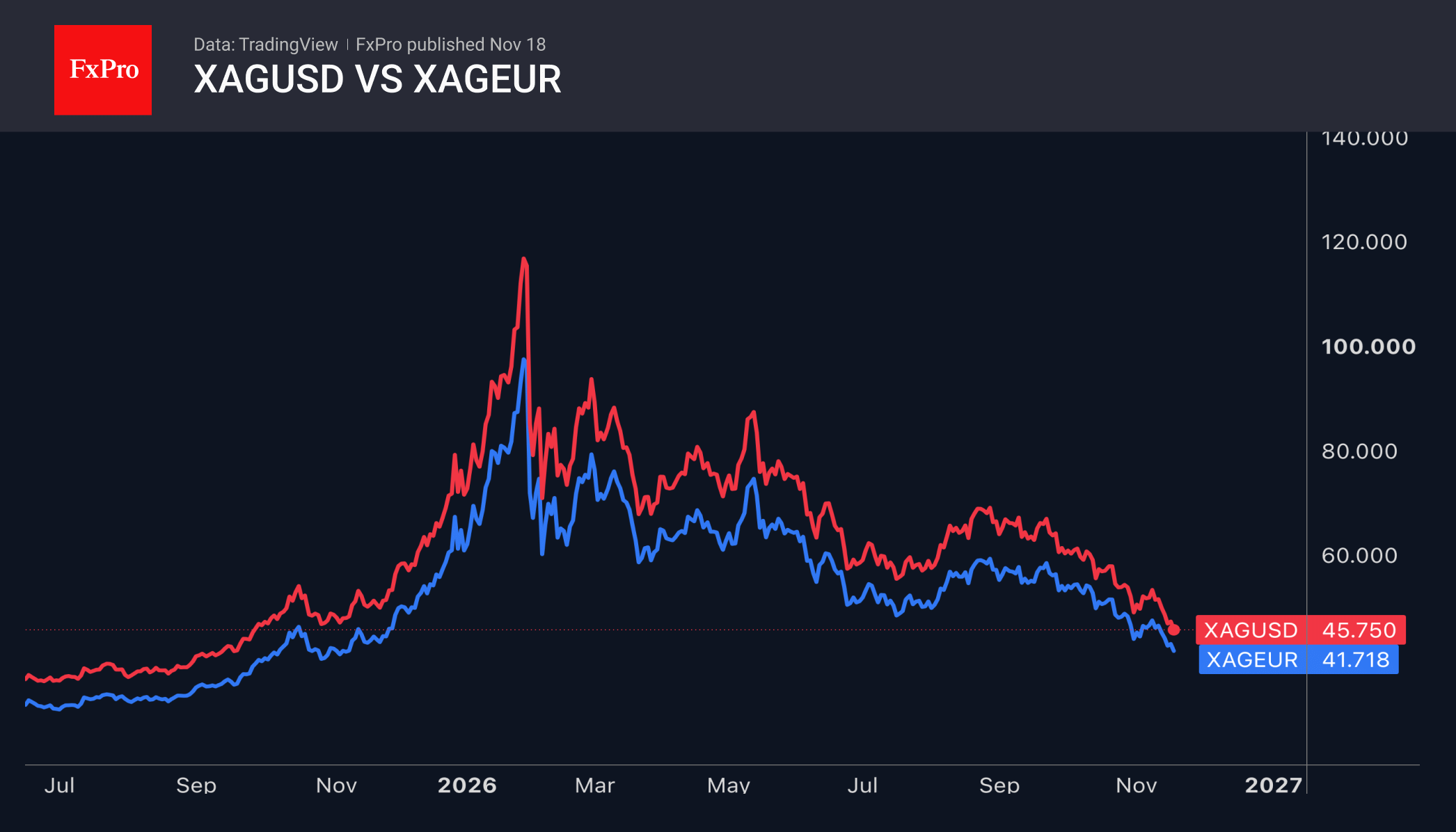
After a stellar 2025 for precious metals, the sector has slumped this year. Over the last month, gold has dropped by 9.5% while palladium lost 15% and platinum 17%. Silver is faring even worse, having lost more than 21% of its value. The main reasons include an unfavourable external environment, a decline in demand for physical assets and a sharp drop in speculative buying.
Source: TradingView, as of 18 November 2026.
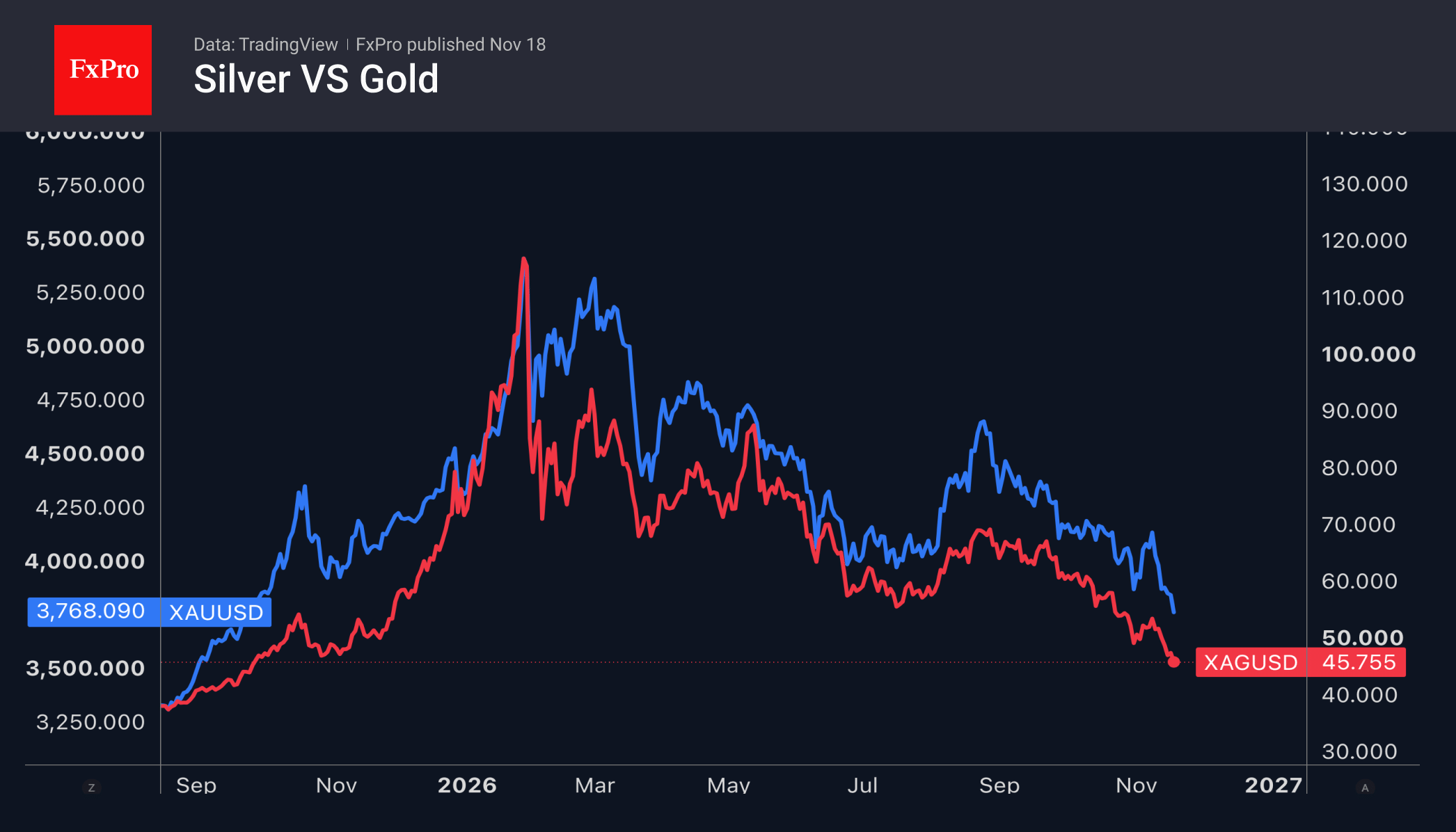
After a 147% rally in 2025, silver gained another 70% at the start of 2026, but by the end of January, the bubble had burst. FOMO led to increased speculative buying: traders were snapping up whatever was rising, ignoring the fundamentals. While we saw heightened volatility from February through August, with heavy selling on rallies, the price has been steadily declining since late August. On 18 November, the white metal plummeted to $45.1, the lowest level since September 2025. Even in euro terms, the situation is not much better.
The commodities market is cyclical: as prices rise, demand falls. According to the Silver Institute and Metals Focus, it will decline by 5% in 2026. However, this will not be enough to balance the market: a sixth consecutive annual deficit is expected, at 35 million ounces, following a 2025 deficit of 54 million ounces. Industrial demand will decline by 3%, and jewellery consumption by 22%. Of particular concern is the decline in interest from solar panel manufacturers, who have made a significant contribution to global demand over the past five years. At the same time, industrial demand outside photovoltaics is expected to rise by 4.5%, according to the Silver Institute, partially offsetting lower consumption in solar panels, where high silver prices have accelerated thrifting and substitution.
Source: TradingView, as of 18 November 2026.
BMO Capital Markets believes that market equilibrium should be defined as the difference between silver production and consumption by manufacturers and jewellers. Under these circumstances, investment demand is the key determinant of above-ground stocks and prices, and in this regard, silver has little to boast about.
Silver’s sharper decline relative to gold is not solely due to its higher volatility. As of early November, the holdings of silver-focused ETFs stood at 1.25 billion ounces, down 4% from the start of January. Metals Focus expects an outflow of 45 million ounces by the end of 2026, following an inflow of 278 million ounces in 2025. In contrast, holdings of gold ETFs rose by 246 tonnes in January–October, marking the third-largest increase on record.

What to watch
Base case: in our view, as long as outflows from silver ETFs and the slump in speculative demand continue, pressure on silver will persist.
Risk and invalidation: a return of gold above $4,000 and silver above $55 would invalidate the bearish scenario.
Upcoming: the FOMC minutes on 18 November at 19:00 GMT; speeches by Christine Lagarde on 19 and 20 November; the final University of Michigan consumer sentiment and inflation expectations on 20 November at 15:00 GMT. Check the economic calendar for more events.
The FxPro Analyst Team