


Brent is being dragged down by the surplus
November 17, 2026 @ 15:49 +03:00
by /  Add FxPro.News on Google
Add FxPro.News as your preferred source to see more of our posts on Google.
- Oil has grown weary of geopolitics and is now trading based on fundamentals.
- Brent’s decline is being driven by the market’s return to a surplus.
The US dollar has returned to highs last seen before Donald Trump imposed large-scale tariffs. At that time, it was believed that import duties would slow the economy, as they would weigh on US companies and households, forcing the Fed to cut rates. At the same time, mistrust of the White House’s policies triggered a capital outflow from the US securities market. In reality, the opposite happened.
The boom in artificial intelligence companies brought non-residents back to buying US stocks, and the US economy picked up steam. The rise in oil prices triggered by the conflict in Iran forced the Fed to shift from easing monetary policy to tightening it. The dollar dominates the forex market, and even the latest drop in oil prices is not helping EURUSD.
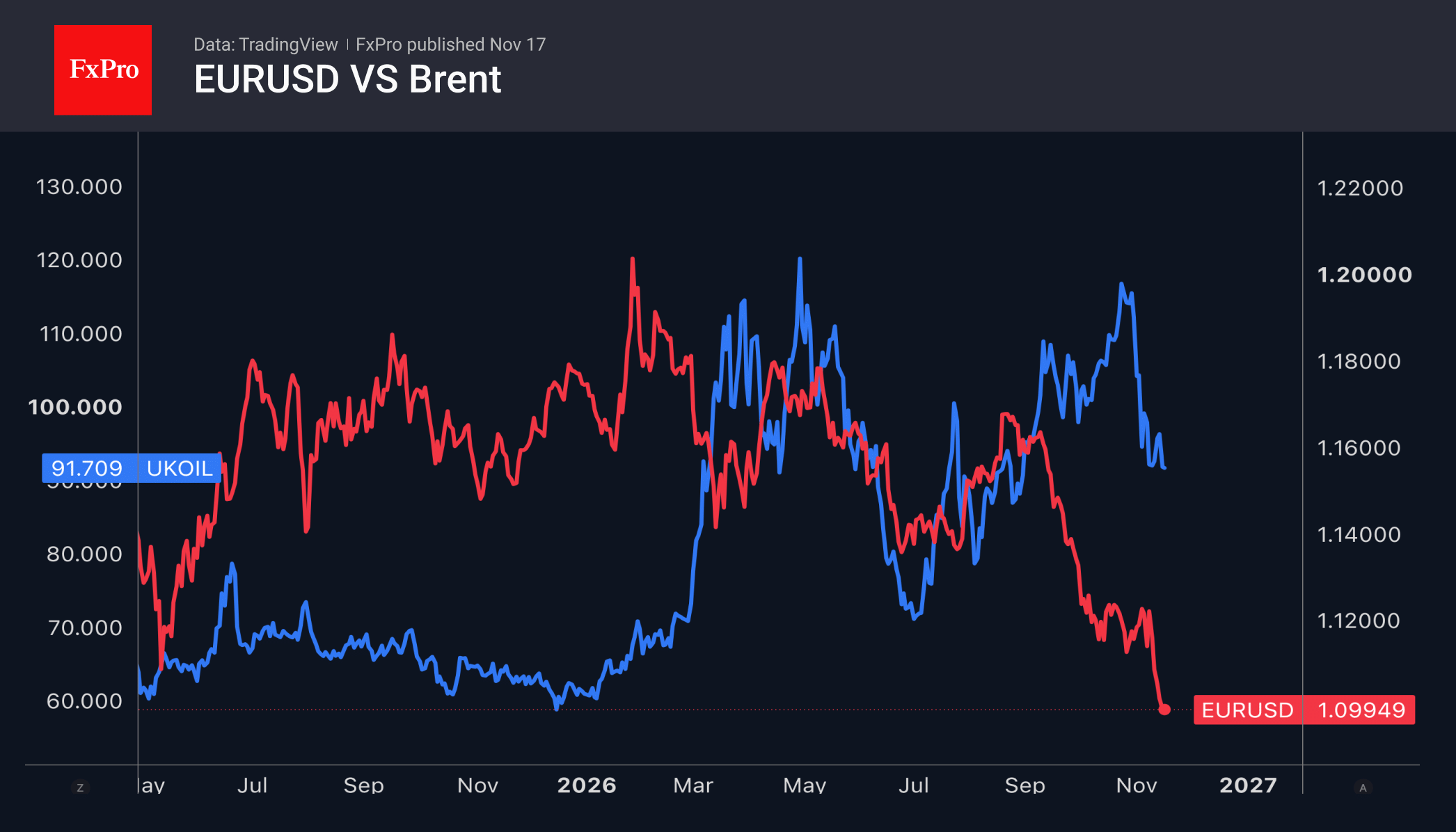
Source: TradingView, as of 17 November 2026.
The oil market has stopped paying attention to geopolitical headlines and has begun trading based on actual supply. Investors have finally acknowledged that supply is outpacing demand, which plays into the bears’ hands.
Goldman Sachs forecasts a surplus of 2 million barrels per day in 2027, as Middle Eastern producers restore production to previous levels and high prices curb demand. In addition, supply is growing elsewhere, first and foremost in Brazil. Meanwhile, according to the latest reports, Saudi Arabia has increased production to 10.5 million barrels per day. There are also reports of a significant increase in production in Iraq and Kuwait. Combined with consistently high US production of 14 million barrels per day, this creates a bearish market environment. The bank forecasts that Brent will average $88 per barrel next year, falling to $78 by year-end.
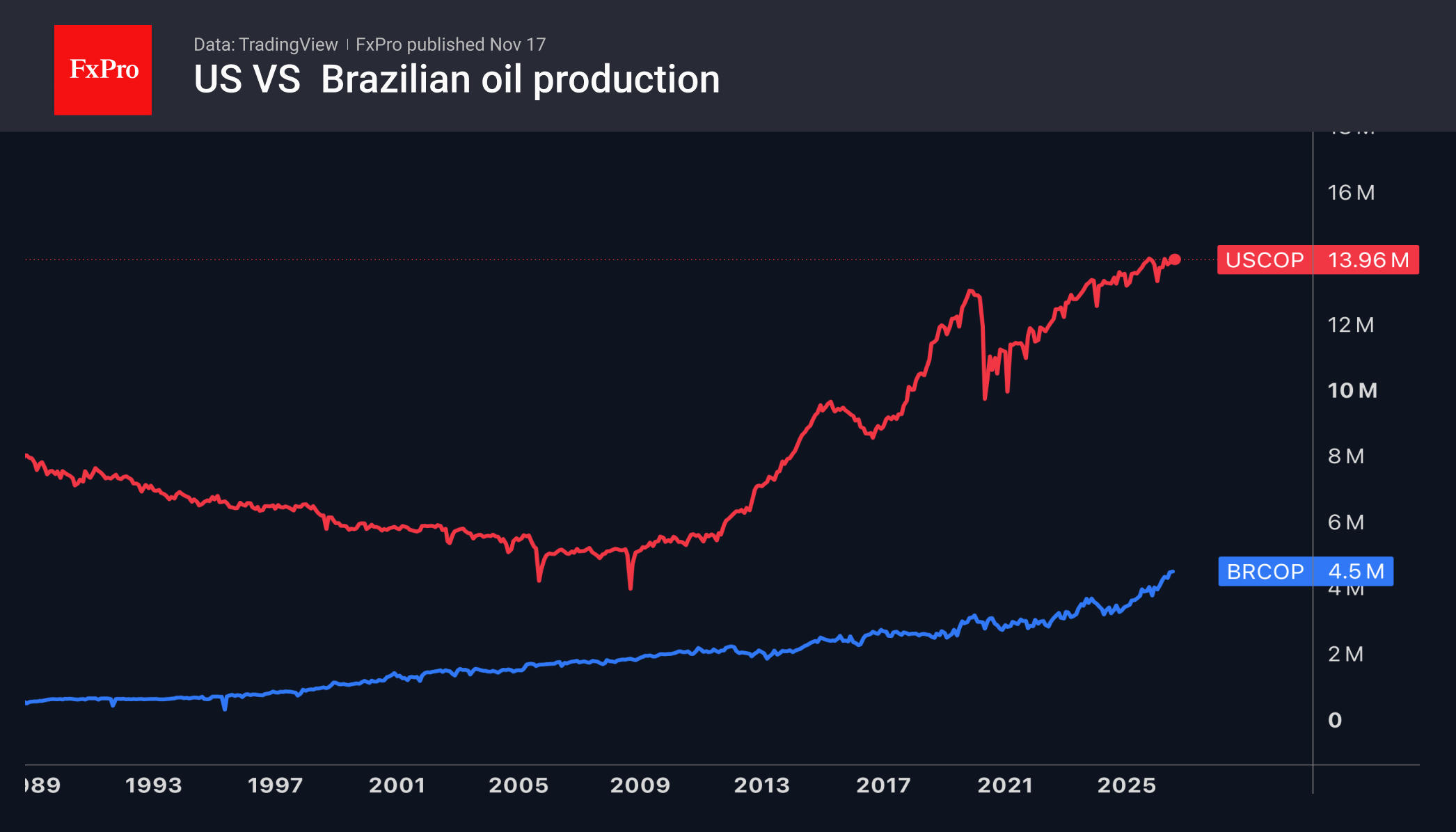
Source: TradingView, as of 17 November 2026.
JPMorgan believes the oil market has already returned to a surplus. The bank estimates the surplus at 1.1 million barrels per day in September and 1.4 million barrels per day in October. The IEA expects the market to return to balance by the end of this year, as the growth in exports is outpacing the recovery in demand. Without an escalation of the conflict, the surplus could grow to 3.8 million barrels per day by the end of 2027.

Prices are under pressure following reports that China has resumed building up its oil stockpiles for the first time since July. This was driven by a recovery in imports and weak refining volumes. According to Reuters estimates, refineries processed 490,000 barrels per day less in October than they could have, given imports and domestic production.
Separately, oil is being weighed down by a strengthening dollar and pressure in the stock market, which is dampening risk appetite.
Since the start of last week, Brent has been trading near its 200-day moving average. Although it does not serve as a strict support or resistance level, it provides a good indication of the market regime: the market remains bullish but is currently undergoing an important test of its strength. From May 2024 to January 2026, rallies above this curve quickly attracted sellers, while since February 2026, dips below this line have spurred buying activity. If technical factors come into play alongside the fundamentals, the price decline could be quite rapid; however, to avoid ending up on the wrong side of the trend, in our view, it would be wiser to wait for confirmation of a reversal in the form of a Brent drop below the most recent significant lows near $85 per barrel.
What to watch
Base case: in our view, the oil market is shifting into surplus, but the bullish regime remains intact as long as Brent holds near its 200-day moving average and above $85.
Risk and invalidation: a Brent drop below $85 would confirm a bearish reversal; the risk for the bears is a fresh escalation in the Middle East.
Upcoming: US crude inventories from the EIA on 18 November at 15:30 GMT; the FOMC minutes on 18 November at 19:00 GMT. Check the economic calendar for more events.
The FxPro Analyst Team