


The US stock market rebound may falter
October 13, 2025 @ 17:40 +03:00
US stock index futures are rising after a disastrous Friday, when Trump’s aggressive response to China’s tariffs shook the markets. The US president’s announcements were carefully timed, with the most aggressive measures (additional 100% tariffs on Chinese goods) announced after the market closed. Over the weekend, US and Chinese leaders appeared to reach out to each other, offering opportunities for further discussion and a deal.
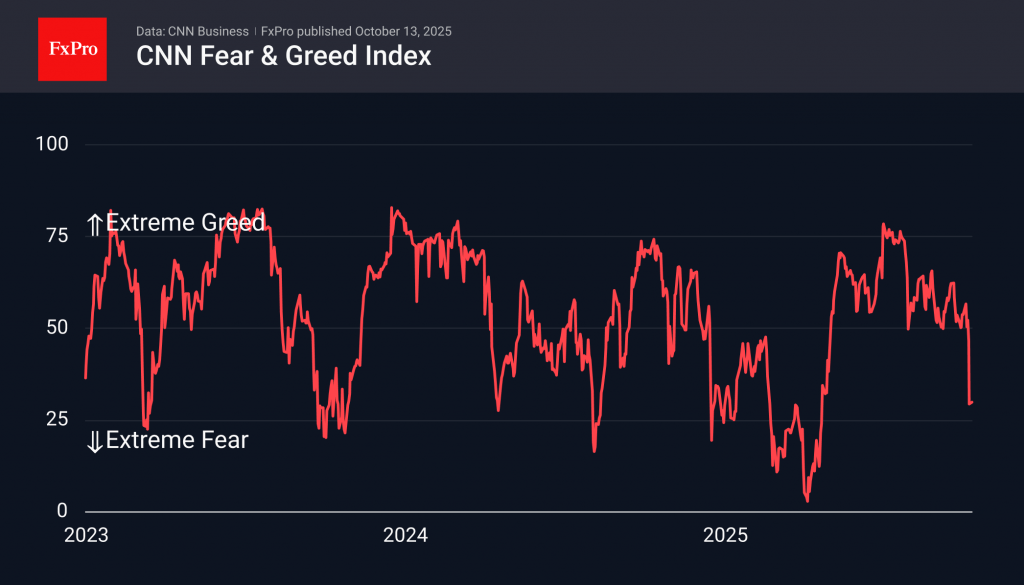
Market sentiment was close to extreme fear, with the Fear and Greed Index falling to 29 on Friday and recovering to 30 on Monday. These are the lowest values since the end of April, when the market was recovering from the “liberation day” effect on Trump’s tariffs.
In the last couple of years, this index has entered the extreme fear zone before we saw a reversal in the indices. This means that bears may exert another round of pressure on the markets. It is easy to link this to further toughening of mutual rhetoric between China and the US, albeit with the possibility of dialogue remaining open. In other words, in this case, it is worth talking about a decrease in the intensity of mutual recriminations, but not about a reversal in relations. From this, we can conclude that the risks that caused the markets to collapse on Friday remain.
We also note that the S&P 500 is trading at a significant distance from its 200-week moving average, near which the market has ended its declines over the past 14 years since 2011, touching it or turning around within 2-5% of it. This contrasts sharply with the current situation, where the S&P 500 is almost 25% above this line.
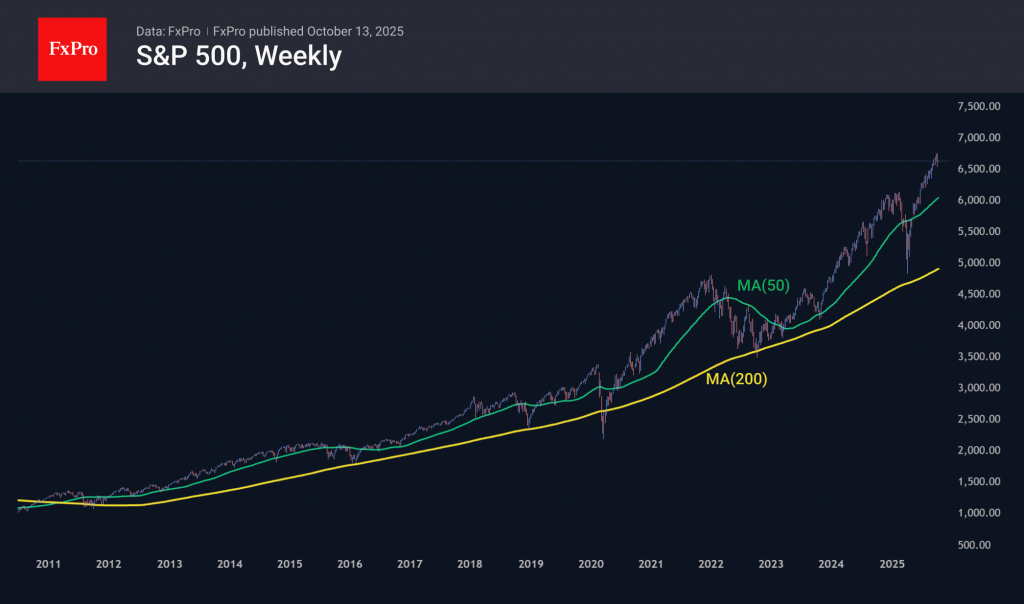
If we talk about a correction within a bull market, then the target for bears seems to be the 6100–6150 range, where the 50-week moving average and last winter’s highs are concentrated. Movement in this direction looks like a viable strategy for the final quarter of the year, unless there is a real reversal in the rapprochement between China and the US, which we highly doubt.

In addition, seasonal factors are also temporarily on the side of the bears, given the more than 40% growth from the lows of the year in early April, the suppressed volatility of the last month and a half, and the tendency to look for new patterns in the markets in the final months of the year. If that’s not enough, add to this the fact that the economy is beginning to feel the effects of tariff wars and a deteriorating labour market, and AI is no longer a novelty. In these conditions, it will be increasingly difficult for traders to find reasons for local purchases.
The FxPro Analyst Team