


Bitcoin dips below short-term support
February 17, 2026 @ 12:02 +03:00
Market Overview
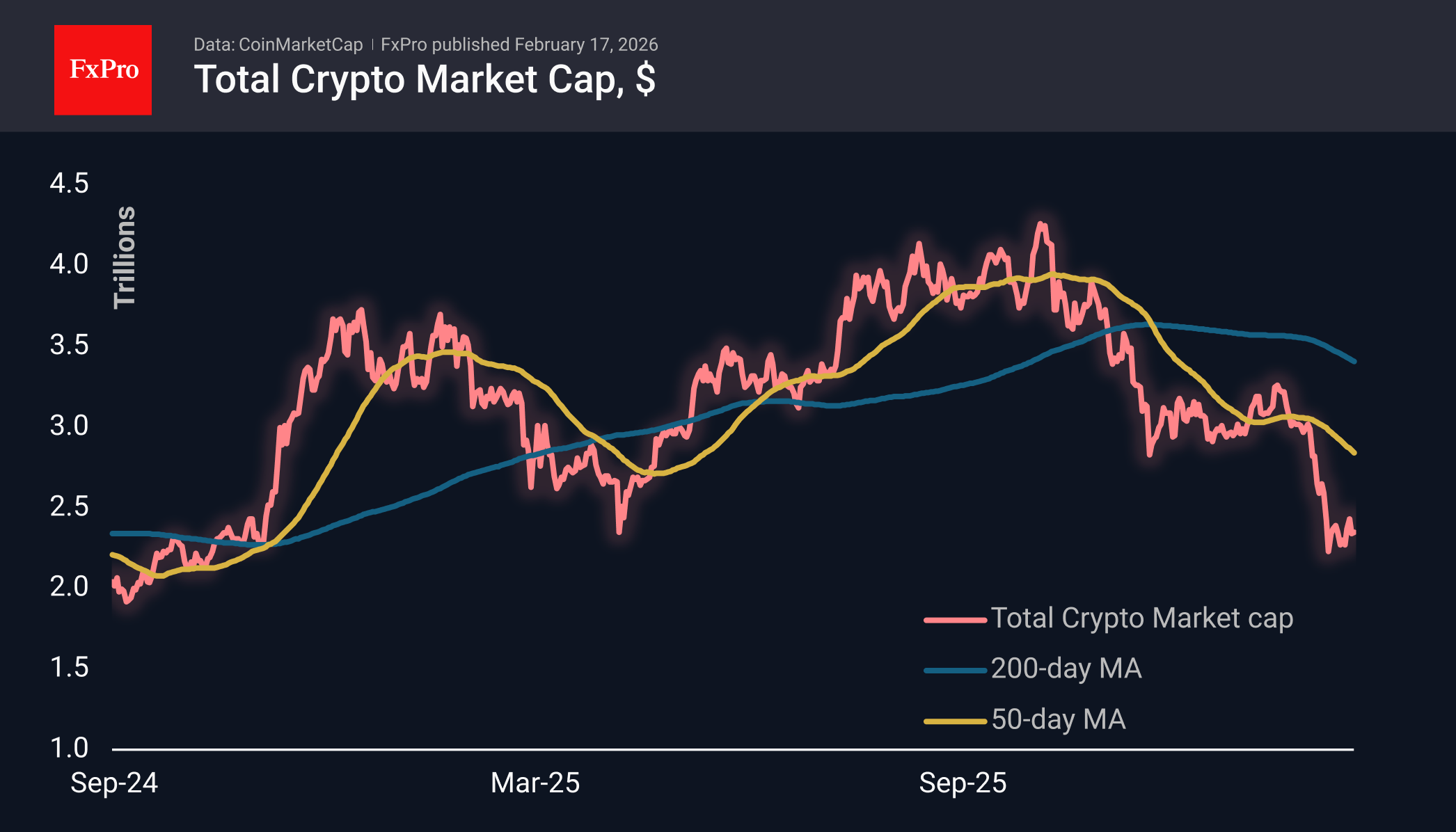
The crypto market cap stood at $2.35 trillion on Tuesday morning, roughly the same as it was yesterday and seven days ago. The leaders in growth among the most liquid coins over the past week are the anonymous Zcash and Cosmos, which are widely involved in the tokenisation of debt assets, adding over 20%. At the same time, the leaders in decline during this period are Ethereum (-1.7%), BNB (-1.5%) and Bitcoin (-1.1%). The decline of the largest coins is an ominous sign for smaller ones, as it may soon pull them down with it at an accelerated pace.
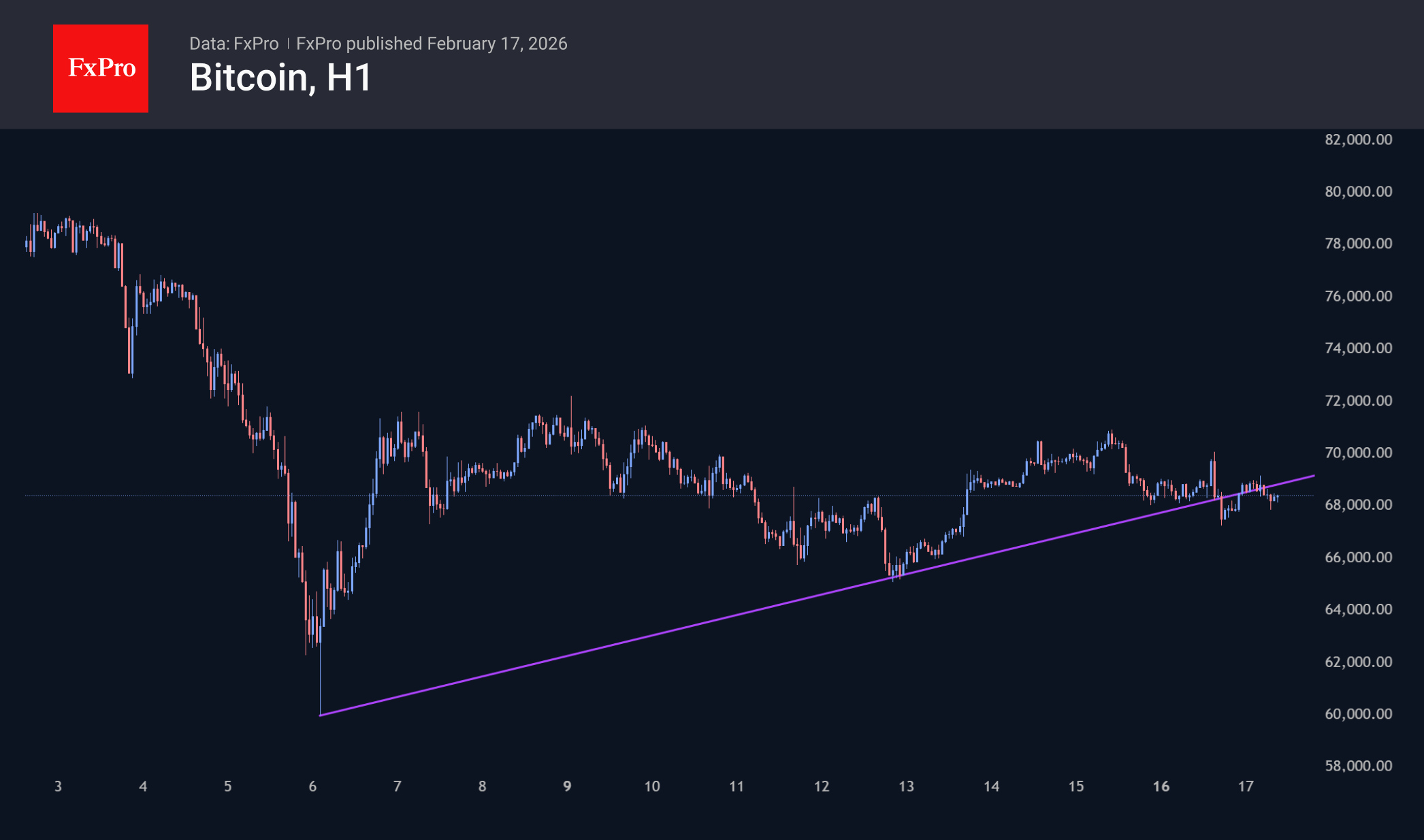
Bitcoin technically fell below the support line that ran through the extreme lows of the first half of February, as another attempt to break above $70K on Monday attracted the interest of sellers, which quickly pushed the price back to $67K. On Tuesday morning, BTC is trading near $68K, where it was the day before, but the former support now looks like local resistance. Confirmation of this trend reversal will be a fall below the recent lows of $67K, with subsequent targets at $65K and $60K.
News Background
The current situation is more reminiscent of a change in the global BTC trend than a local correction, according to CryptoQuant. The market has already entered a ‘stress zone’ but has not yet reached the stage of final capitulation. To form a ‘true bottom,’ a peak in loss-taking and a complete exhaustion of selling pressure are necessary.
Capriole Investments founder Charles Edwards cited the quantum threat as one of the reasons for the current BTC correction. In contrast, Benchmark considers such fears to be exaggerated, and Blockstream expects supercomputers to appear only in 20-40 years. Growing attention to the threat of quantum computing is beginning to reduce the long-term appeal of Bitcoin compared to gold, said analyst Willy Woo. In his opinion, about 4 million ‘lost’ coins could be dumped on the market after a quantum computer hacks Bitcoin.
Blockstream CEO Adam Back criticised the BIP-110 update aimed at combating ‘spam’ on the Bitcoin network. He called the initiative a threat to the reputation of the first cryptocurrency.

In the fourth quarter, Harvard University’s management company withdrew more than 20% of its investments from the Bitcoin ETF, investing in an Ethereum-based ETF for the first time. Despite the partial sale, Bitcoin ETF shares remain the most significant public asset in Harvard’s portfolio.
The FxPro Analyst Team