The dollar index rises over the course of five trading sessions out of the last six, amid growing demand for defensive assets. German and Japanese bond yields go deeper into negative territory, 10-year UST yields increasingly deeper below 3 months yield.
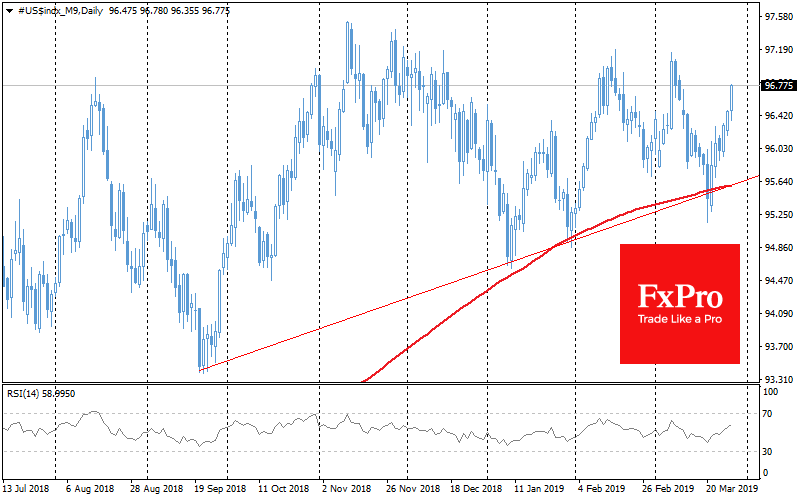
At the same time, one after another, central banks continue to soften rhetoric, putting additional pressure on interest rates. The ECB and the Fed seem to be competing in softening. So far, Draghi wins this stage, noting in his recent speech that the rate increase may be further delayed. Over the past month, a sharp softening of the rhetoric was also demonstrated by the Bank of England, the RBA, the RBNZ.
As a result, one after another, the national currencies of these countries falling under pressure, which should support national markets. However, Central Banks should pay attention to the consequences of their words.
The wary tone of central banks is increasingly affecting markets. In our opinion, the caution of such a high level somewhat does not correspond to real economic indicators. They are declining, but not as much as we can talk about an imminent recession.

One way or another, investors are increasingly set to lower rates, and the demand for defensive assets pulls the U.S. Dollar and Japanese Yen up, at the same time acting as an important obstacle to the growth of stock indices. The markets are so arranged that if regulators talk about problems, then there will definitely be problems.
Stock indices do not demonstrate significant dynamics, as was the case at the end of last year, but it is worth noting that at that time there was a need for correction on the markets after a prolonged growth, but now the situation is different. However, the VIX volatility index moved away from the mid-March lows, reflecting expectations of increasing volatility.
Will central banks be able to escape from the “softening trap”? Probably, yes. But they will need some starting point, which can be a trade deal between China and the United States. However, it cannot be excluded that the central banks are trying to solve the problem of structurally low economic growth rates by weakening their own currencies. This is more like the Beggar-Thy-Neighbor policy, which at the beginning of the 20th century is considered to be the cause or at least one of the factors that tightened the Great Depression.

Alexander Kuptsikevich, the FxPro analyst